We Were Experts at Nothing
I'm Gen X, which means I spent a good part of my childhood doing absolutely nothing, and I was very good at it.
I grew up in Manila so it's like hot afternoons when we were sent to take a siesta and lay there watching the ceiling fan go round instead. Power outages that brought the whole street outside, kids and "titas" on the steps, fanning themselves and waiting for the lights to come back. Watching the rain pour off the roof in typhoon season. Sitting by the gate listening for the taho vendor's call. Nobody scheduled it. Nobody filmed it. It was just time, and we lived inside it.
I was reminded of this reading a lovely essay in 1000 Libraries Magazine about My Neighbor Totoro and the lost art of doing nothing. The film has no villain and no big plot. Two little girls explore, wait, wander and nap. In the famous bus stop scene, they stand in the rain waiting for their dad, and a giant forest spirit simply comes and waits beside them.
Miyazaki has a word for those pauses: ma. The empty space between the action. Without it, he says, it's just busyness.
I read that and immediately thought about our dogs.
The Dog Version of an Overbooked Childhood
The essay points out that kids have lost hours of free play every week over the past few decades. Their days got filled. Lessons, screens, structured activities, all well meant.
We are doing the same thing to our dogs, and we're doing it out of love.
Monday is agility. Tuesday is daycare. Wednesday is the long fetch session because he "needs to burn it off." Every meal comes in a puzzle toy. Every walk has a goal: miles logged, a training rep, a photo for the group chat. If the dog is lying on the floor doing nothing, a lot of us feel a little flicker of guilt. Is he bored? Should I be doing more?
The message dog guardians hear everywhere is that a good life means more. More exercise, more enrichment, more activities, more stimulation. Extra everything.
But more of one kind of thing is not the same as a full life. A dog whose days are packed with high-energy, human-directed activity is living a narrow life, just a loud one.
Behavior Diversity: The Quiet Half of Being a Dog
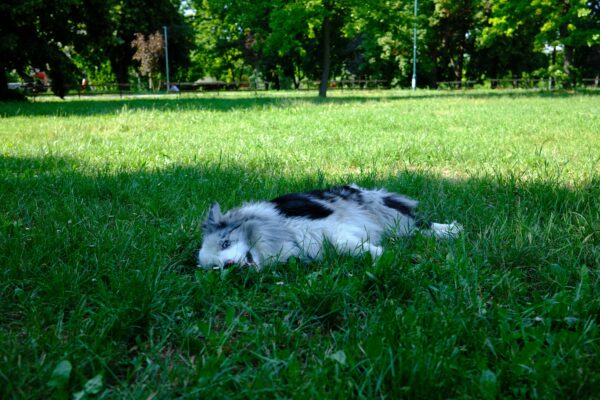
Watch a dog who has real choice over their day and you'll see a wide range of behavior. Sniffing a single patch of grass for two full minutes. Lying in a sunbeam. Watching birds from the porch. Digging a little. Rolling in something. Sitting next to you and just looking out at the world.
None of it looks productive. All of it matters.
This is what behavior diversity means. A healthy dog gets to express the full spread of who they are as a species and as an individual, not just the high-arousal slice we tend to schedule. When the calendar only holds running, chasing and performing, the quieter behaviors don't get a turn. And those quieter behaviors are doing real work.
Sniffing is how dogs think. Slow, nose-down exploring lets a dog take in their world at their own pace. Researchers found that dogs given regular nosework sessions became more optimistic in their outlook than dogs given heelwork. Choice and curiosity, not obedience, shifted how they saw the world.
Rest is when learning sticks. There was a study that out found that dogs who slept after a training session remembered what they learned better. Adult dogs naturally sleep a large part of the day. That isn't laziness. It's maintenance.
Calm is a skill, too. A dog who only ever practices being revved up gets very good at being revved up. Ball-obsessed dogs, dogs who can't settle at home, dogs who seem to need "more" every week: often this is a nervous system that rarely gets to come back down. More exercise builds a fitter athlete, not a calmer dog.
The essay borrows an idea from psychologist Stephen Kaplan: soft fascination. Rain, clouds, leaves moving in the wind hold our attention gently, without demanding anything, and that's what lets a tired mind recover. Dogs get this too. A breeze full of smells. A creek. Birds in a hedge. It's restorative precisely because nobody is asking them to do anything about it.
In a welfare-first view, behavior and well-being are never separate. A dog who gets to rest, sniff and simply observe is a dog whose body and brain are getting what they need to cope with everything else we ask of them.
What Doing Nothing Looks Like With a Dog
This isn't about cancelling agility or throwing out the puzzle feeders. It's about leaving some ma in your dog's week. A few ideas:
- The wander walk. Long line, quiet trail or park, no destination. Your dog picks the pace and the direction. If they want to sniff one stump for five minutes, that's the walk.
- Sit spot. Find a bench, a patch of grass, a back step. Sit together and watch the world. No cues, no treats, no phone. Just two animals noticing things.
- Let them watch. A window seat or a safe spot on the porch can be one of the richest parts of a dog's day.
- Protect the nap. If your dog is resting, let them rest. Not every quiet moment needs filling.
- Notice what they choose. When you give your dog an unscheduled hour, what do they actually do with it? That tells you a lot about who they are.
The first few times, it might feel like you're doing it wrong. Most of us have forgotten how to sit with nothing. Our dogs never needed to learn it. They just need us to make room for it.
In our neurodivergent household, I see this with the kids too. Their weeks fill up fast with school, appointments and all the extra support, and the empty hours are usually the first thing to go. But those are often the hours they need most, to come down from a day of noise and masking and find their own pace again. So we try to protect a little nothing for everyone under our roof, dogs included.
Permission to Do Less
In the film, the girls plant seeds Totoro gave them and wait. For days, nothing seems to happen. Then one night, everything grows.
That's what the quiet hours do for our dogs. Something is settling, processing, growing in the time that looks empty from the outside. A dog's life isn't better because we filled it. It's better when it has room for all of who they are.
If your dog seems restless, over the top, or never quite able to switch off, more activity may not be the answer. It might be the opposite. A Behavioral and Wellness Assessment is a good place to start looking at the whole picture: what your dog's days actually hold, what's missing, and what they're telling you about it.
So here's my question for you: when was the last time you and your dog did absolutely nothing together?



Leave a Reply