• Skip to main content
  • Skip to primary sidebar
  • Skip to footer

R+R Canine Consulting

Certified Family Dog Mediator and Professional Dog Trainer

  • Home
  • About
  • Work with Me
  • Blog
  • Shop
  • Contact

Two Nervous Systems, One House: When Your Dog and Your Child Are Both Dysregulated

May 11, 2026 by Jennyfer Tan Leave a Comment


Picture this.

It's an ordinary afternoon. Nothing has gone obviously wrong. But something is off with my son — I can feel it before I can name it, the way you learn to read the air in a house after enough years. He's louder than usual, which for him means very loud. He's moving through the apartment with that particular quality of motion that I've learned to recognize — not quite purposeful, not quite lost, somewhere between the two. Choppy. A little too fast around the corners.

And Rosco, who had been settled on his bed, is no longer settled. He's up. He's tracking. His eyes are following my son around the room with an alertness that is not relaxed curiosity — it's something more like vigilance. His body is still but it's the wrong kind of still. Held, not resting.

My son doesn't notice. He's already somewhere inside whatever is building in him, and there's no bandwidth left over for reading the dog. He moves past Rosco too close, too fast, voice still at full volume mid-sentence. Rosco flinches — small, quick, the kind of thing you'd miss if you weren't watching — and then repositions himself, just slightly further away.

Nobody did anything wrong. And yet something is happening in that room that, if I don't intervene, will keep escalating on its own.

This is the moment I want to talk about.

There's a concept in nervous system science — not just in dog behavior, but in human neuroscience too — called co-regulation. The idea is that nervous systems don't operate in isolation. They respond to each other. A calm nervous system in the room can help a dysregulated one settle. And a dysregulated nervous system in the room can pull a calm one toward activation.

We see this in dogs all the time. A tense handler produces a tense dog, even when the handler is doing everything technically right. A panicked guardian at the vet makes the already-anxious dog harder to examine. The dog is not reading the situation independently — they're reading the person, and calibrating accordingly.

But it works the other way too. And this is the part that matters for families like mine.

When my son is dysregulated — when his voice is too loud, his movement too erratic, his frustration spilling out into the physical space around him — Rosco's nervous system responds. Not because Rosco is making a decision about it. Not because he's judging my son or reacting to anything intentional. But because his nervous system is doing exactly what it was built to do: scanning the environment, picking up signals, and adjusting his own state accordingly.

Two nervous systems, reading each other. Both of them escalating. Neither of them choosing to.

What makes this particular dynamic so hard to see — and so hard to interrupt — is that it's invisible until it isn't.

It doesn't start dramatically. It starts with Rosco a little more alert than he was five minutes ago. It starts with my son's voice a fraction louder than it was when he came in. Small things, building on each other, feedback looping in a way that has no obvious beginning and no obvious solution if you wait too long to notice it.

And when you're the parent in that house, you're often the last to see it. Because you're tracking your son. You're reading the early signs in him, trying to figure out what's driving it, trying to decide whether to engage or give space, trying to regulate your own response so you don't add another dysregulated nervous system to the room. You're already doing three things at once before you've even registered that the dog is involved.

I've been in that room more times than I can count. And I'll be honest: for a long time, Rosco barely registered. He was in my peripheral vision at best. My son was the priority, and everything else fell away.

That's not a failure. That's triage. But it did mean that for a long time, I had no idea what Rosco was absorbing.

Here's what I know now that I didn't know then.

By the time Rosco is visibly reactive — stiff, hyper-alert, unable to settle — he has already been communicating for a while. The yawn that I read as tiredness. The lip lick I didn't notice. The way he got up from his bed and moved to the other side of the room so quietly that I didn't register it as a choice.

Dogs rarely go from fine to not fine in one step. There's a ladder, and Rosco climbs it rung by rung. The problem is that a household in the middle of managing a dysregulated teenager doesn't always have anyone watching the ladder.

And here's what makes it a feedback loop rather than just two parallel events: Rosco's escalation doesn't stay invisible. At some point it becomes visible — a bark, a sudden movement, a decision to put himself somewhere he shouldn't be — and that visible escalation adds to my son's environment. Another unpredictable thing. Another input into a nervous system that is already overwhelmed. Which can tip him further. Which Rosco reads. Which tips Rosco further.

This is not a behavioral spiral. It's a physiological one. Neither of them is being difficult. Both of them are responding to real signals from their real environment. The signals just happen to be each other.

I want to be careful here about what the solution looks like. Because the instinct is to intervene in the dog. Remove him, redirect him, manage him. And sometimes that's the right immediate call. Creating physical separation when both nervous systems are activated is often the kindest and most practical thing you can do in the moment.

But management in the moment isn't the same as understanding what's actually happening. And if your only tool is separating them when things get bad, you're responding to the top of the ladder every time instead of the bottom.

What I've had to learn is to watch for the bottom.

For Rosco, the bottom of the ladder is subtle: a shift in his posture, in how he's sitting, ears that are just a little more forward than relaxed, a stillness that has tension behind it. If I see that and respond — creating some space before things build, giving him somewhere to go that's genuinely quiet, stepping in to interrupt an interaction that's getting too loud or too close — we don't climb.

For my son, the bottom of the ladder has its own signals, and after twenty-plus years I know most of them. The quality of the silence before the volume goes up. The way he moves when something is already stacking. I can't always act on what I see in him — sometimes the right thing is to let him process without intervention. But when I can see both ladders rising at the same time, that's my cue to do something about the dog's side of the equation, because that's the side where I have more room to act.

The hardest part of writing this is that it doesn't resolve cleanly. My son is older now. He's a young adult navigating the world in ways that genuinely impress me, building the kind of skills I once wasn't sure he'd have access to. Some of what used to happen regularly doesn't happen as often. The sharpest edges of those years have softened.

But Rosco is still a reactive dog with a nervous system that stays alert in a busy household. There are still days when the load is high and the feedback loop threatens to start. There are still moments where I'm watching both of them and doing the quiet math of what each one needs and whether I have enough to give it.

What's different now is that I see it. I see the loop before it closes. I know what I'm looking for and I know, roughly, what to do when I find it.

That's not a dramatic transformation. It's just attention, accumulated over time, pointed in the right direction.

If you're in a household where this is your reality — a neurodivergent family member and a dog, both of them working hard, both of them occasionally pushing the other toward the edge — I'm not going to tell you it's simple. It isn't. The demands are real and they don't always leave much margin.

But I will tell you this: the loop is interruptible. Not always, and not at the top. But earlier, when things are still small, when the signals are still quiet — there's usually a moment where one deliberate action can change the trajectory for both of them.

You don't have to manage both at once. You just have to notice which one you have room to help right now, and start there.

Most of the time, that's enough to stop the climb.


If you're trying to understand what your dog's stress signals actually look like — before things escalate — a Behavioral and Wellness Assessment can help you build that picture. We look at the whole environment, not just the behavior in isolation.

____________________________________________________________________________________

The Dogs & Neurodivergent Families Series
What Raising My Child with Autism Taught Me About Understanding 'Difficult' Dogs
Stop Drilling Commands, Start Teaching Skills: A Mom and Dog Trainer's Perspective
Progress Is Not a Straight Line
What Your Dog Is Living Through in a Neurodivergent Home
Two Nervous Systems, One House: When Your Dog and Your Child Are Both Dysregulated (coming soon)
Choosing a Dog When You Have a Neurodivergent Child: What the Breed Lists Don't Tell You (coming soon)
The Bond That Looks Different: When Your ND Child and Dog Find Each Other (coming soon)
What Nobody Tells You About Having a Dog in a Neurodivergent Home (coming soon)
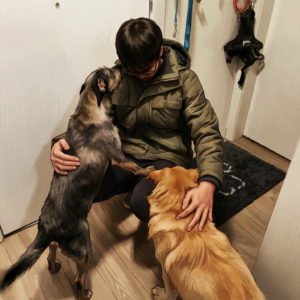
Filed Under: Dogs & Neurodivergent Series, Insights

What Your Dog Is Living Through in a Neurodivergent Home

April 20, 2026 by Jennyfer Tan Leave a Comment

This post is part of the Dogs & Neurodivergent Families series — an ongoing collection of essays on what it actually looks like when a reactive dog and a neurodivergent family member share a home. Written from two perspectives: Certified Family Dog Mediator and parent. You can read the series from the beginning here, or jump to any post below.

We got Rosco when my son was seventeen.

I want to say that because it matters. People imagine a young child when they picture a neurodivergent kid with a dog — small, easily redirected, manageable in scale. My son at seventeen was none of those things. He was a teenager. A big one. And he moved through the world the way a lot of autistic people do — with heavy hands, heavy feet, no real sense of how much force he was using until it had already been used.

His voice is either loud or almost inaudible. There's very little in between. When he's happy and engaged, he's loud. When he's frustrated, he's loud in a different way — sharper, and his body changes with it. The movement becomes choppy. Erratic. Like a signal breaking up. It doesn't look like anger to me anymore, not after all these years, but it reads as unpredictable. And unpredictable, to a dog, is its own kind of loud.

I knew all of this about my son. I had seventeen years of knowing it. What I hadn't thought about — not really, not until Rosco was in the house and I started paying attention — was what my son's body language looked like from Rosco's perspective.

Dogs are sensory animals living in a sensory world. They track movement, sound, smell, tone, posture — constantly, involuntarily, because that's what their nervous system is built to do. Unpredictable movement isn't just surprising to them. It's data. It says: something is happening that I can't predict. I don't know what comes next. And a nervous system that can't predict what comes next is a nervous system that stays on alert.

My son wasn't trying to be unpredictable. He wasn't doing anything wrong. The heaviness in his hands when he reached for Rosco wasn't carelessness — it's simply how he's wired, how he experiences his own body in space. His voice at full volume wasn't aggression — it's just where his volume dial tends to sit. And when he got frustrated and his movement went choppy and sharp, that wasn't a threat. It was his nervous system doing what it does.

But Rosco didn't know any of that. Rosco just knew what he was sensing: a large, unpredictable presence that was sometimes gentle and sometimes sudden, whose voice spiked without warning, whose body shifted in ways that were hard to read. All of that was going into Rosco's stress bucket — sometimes a little at a time, sometimes quite a lot at once — whether or not anyone in the room was tracking it.

I was often not tracking it. I was tracking my son.

There's a version of this conversation that becomes about managing the teenager, or training the dog, and I want to be careful not to go there. Because that's not what I'm talking about.

What I'm talking about is that both of them were navigating something real, and only one of them had anyone paying close attention to how they were doing.

Rosco communicates stress the way most dogs do — in a language that's easy to miss if you haven't learned to look for it. He yawns when he's not tired. He does a full-body shake-off when nothing has gotten him wet. He licks his lips. He repositions himself, just slightly, just out of easy reach. He leaves the room.

That last one is the one I started noticing first. He'd be settled somewhere, and then my son would come in — not doing anything dramatic, just entering the room in that way he has, heavy-footed, maybe mid-conversation with himself or with me, voice carrying — and Rosco would quietly get up and go somewhere else. Not dramatically. Not cowering. Just... choosing a different room.

I knew what it meant by then. He was telling me, in the only way he had: I need a bit less of this right now.

The problem is that a dog who keeps choosing a different room, day after day, in response to a family member, is a dog who is managing chronic low-grade stress. And chronic low-grade stress doesn't always look like a dog in crisis. Sometimes it looks like a dog who is just a little more tense than they used to be. A little slower to settle. A little quicker to startle. You don't always see it building until something tips.

I also had to reckon honestly with the physical piece.

My son's hands are not gentle by default. He has to think about being gentle — consciously, deliberately — in a way that a lot of people don't. When he pets Rosco without that conscious thought running, it's heavier than Rosco wants. And Rosco, to his credit, has learned to say so — he moves away, he turns his head, he does the small things that mean that's enough. But a dog who keeps having to say that's enough is a dog who is working harder than they should have to in their own home.

This is not about blame. I want to say that again because I mean it: this is not about my son being careless, or unkind, or unaware. He loves Rosco. That's not in question. But love doesn't automatically translate into the physical regulation that most dogs need from the humans they live with — and for some people, that regulation is genuinely hard. It requires effort and attention that a dysregulated nervous system doesn't always have available.

So the gap has to be filled somewhere else. And that somewhere else is me.

This is the part that doesn't get talked about in the conversations I've seen about dogs and neurodivergent families: someone in the house has to be the dog's advocate. Not in a dramatic way. Not in a way that pits one family member's needs against another's. Just in the quiet, consistent way of a person who is watching — who notices when Rosco has moved to the far side of the room and understands why, who makes sure there's always a space Rosco can go that is genuinely his, who steps in when an interaction needs to end before Rosco has to say so himself.

This is, in a real sense, what Family Dog Mediation is about. Not training the dog into tolerating more. Not teaching him to override his own signals. But understanding what he needs to feel okay, and making sure those things exist in the house, even — especially — when the house is a lot.

For Rosco, what that has looked like practically: a space that is always his and that my son has learned, over time, to respect. Decompression walks that are genuinely decompression — slow, led by Rosco's nose, not asking anything of him. A predictable rhythm to the day where he can anticipate what's coming, even when other things are unpredictable. And me — paying attention. Not constantly. But enough.

My son has grown into understanding Rosco better than I expected, honestly. It took time, and it took me explaining things in ways that made sense to him — not "be gentle" as an abstract instruction, but specific and concrete: put your hand out, let him come to you, watch where his head goes. He can do it. He just needs the explicit version, not the assumed one. Which, if you've been reading this series, will sound familiar.

Both of them are doing their best with the wiring they have. That's the thing I keep coming back to, in this work and in this family.

My son's heavy hands and his too-loud voice and his choppy, erratic movement when frustration hits — none of that is a choice. It's his nervous system, doing what it does. And Rosco's retreat to the far room, his lip-lick, his quiet preference for the space where things are a little less unpredictable — none of that is a behavior problem. It's his nervous system, doing what it does.

The question is never which one of them needs to change. The question is what understanding looks like when you're holding both of them at once.

Most of the time, for us, it looks like paying attention. Noticing when the bucket is getting full before it tips. Making sure there's always somewhere quiet to land.

That's not a perfect system. Some days are harder than others. But I've learned from both of them that perfect was never the point anyway.

The point is to keep asking: what do you need today? And then actually listening for the answer — in whatever form it comes.


If you've never thought about what your household looks like from your dog's perspective — the sounds, the unpredictability, the moments nobody is watching them — a Behavioral and Wellness Assessment is where that picture gets built. We look at the whole environment, not just the behaviour that comes out of it. Understanding before strategies, always.

____________________________________________________________________________________

The Dogs & Neurodivergent Families Series
What Raising My Child with Autism Taught Me About Understanding 'Difficult' Dogs
Stop Drilling Commands, Start Teaching Skills: A Mom and Dog Trainer's Perspective
Progress Is Not a Straight Line
What Your Dog Is Living Through in a Neurodivergent Home
Two Nervous Systems, One House: When Your Dog and Your Child Are Both Dysregulated (coming soon)
Choosing a Dog When You Have a Neurodivergent Child: What the Breed Lists Don't Tell You (coming soon)
The Bond That Looks Different: When Your ND Child and Dog Find Each Other (coming soon)
What Nobody Tells You About Having a Dog in a Neurodivergent Home (coming soon)

Filed Under: Dogs & Neurodivergent Series, Insights

Progress Is Not a Straight Line

March 25, 2026 by Jennyfer Tan Leave a Comment

This post is part of the Dogs & Neurodivergent Families series — an ongoing collection of essays on what it actually looks like when a reactive dog and a neurodivergent family member share a home. Written from two perspectives: Certified Family Dog Mediator and parent. You can read the series from the beginning here, or jump to any post below.

I know this moment. You've been putting in the work. Weeks, months, and then one day something finally clicks. Your child gets through a loud, chaotic birthday party without falling apart. Your dog walks right past the neighbour's reactive dog, calm as anything. You let out a breath you didn't realize you were holding. You think: okay. We're getting somewhere.

And then two days later, it's like it never happened.

Your child loses it over a cup being the wrong color. Your dog loses his mind at a jogger he's seen a hundred times. Did we go backwards? Did I do something wrong? Are we starting over?

No. You're not starting over. And you didn't do anything wrong.

I've lived this in two very different worlds , as a parent and as a family dog mediator, and the thing both keep teaching me is the same: progress is not linear. Not for neurodivergent kids. Not for dogs. Not for any nervous system trying to navigate a world it wasn't built for.

Why we expect a straight line

We like linear progress because it's easy to track. You learn something, you remember it, you do it reliably. Done. But that model falls apart the moment a real nervous system is involved.

When my son was younger, I kept bumping into this. He'd manage something hard and then a week later it would be like the skill had vanished. What I eventually understood was that it hadn't vanished. It was still there. What wasn't there was the capacity to access it. He hadn't slept well. The school day had been relentlessly loud. There were things stacking up that I wasn't even tracking, and by the time we hit the moment that needed that skill, the tank was already empty.

I see this with my dogs too.

The stress bucket is always filling

In dog behavior work, we talk a lot about cumulative stress — sometimes called the "stress bucket." The idea is simple: every experience adds something. A strange noise in the night. A new smell in the house. An unfamiliar dog barking from down the street. Even a small change in routine. None of these things might seem like much on their own, but they add up. And when the bucket gets full, capacity drops.

This is not a training problem. It's biology.

Dogs have a finite amount of cognitive and emotional bandwidth on any given day, just like we do. Poor sleep raises cortisol. Elevated cortisol makes impulse regulation harder and learning less effective. So a dog who seemed totally fine yesterday — relaxed on leash, unbothered by kids, responsive — might genuinely struggle today, not because they've forgotten anything, but because their bucket was already overflowing before you even clipped the leash.

Rosco is my clearest example of this. He's a reactive dog with a complicated start — medical issues in his first weeks, poor socialization, and genetics that lean hard toward vigilance. On a settled morning, after a calm decompression walk, he can pass things now that would have sent him over threshold six months ago. But if he had a rough night, or there's been noise in our building, or I'm tense and my body is saying so without my realizing it — he picks that up. His threshold shrinks. Same dog, same street, completely different result.

He hasn't forgotten anything. He just doesn't have the room for it today.

Something I had to learn the hard way, both as a parent and in this work, is that skills are context-dependent. They don't get installed once and work everywhere. They get learned in specific environments, with specific emotional states, with specific amounts of sleep and food and felt safety behind them.

My son learned to regulate in quiet spaces first. A calm room at home looked nothing like the cafeteria — loud, unpredictable, overwhelming. He wasn't less capable in noisy environments; he was still building that capacity for that context specifically. Once I stopped reading cafeteria meltdowns as failures and started reading them as information, everything shifted. He wasn't regressing. He was still learning, just in a harder setting.

Same with dogs. A dog with a solid recall in the backyard is not the same dog in a busy park. The park is a completely different sensory and emotional world. The skill has to be rebuilt there, with all of that context factored in. That takes time. It takes a nervous system that has enough left in the tank to actually learn.

When we forget this, we catastrophize. We decide the kid will never manage, or the dog is too far gone. Neither of those things is true. They just need more time in more contexts — and a support system that isn't expecting them to perform at their best when they're running on empty.

We have to always remember: a bad day is information, not a conclusion.

When my son was really struggling, I trained myself to ask a different question. Not "what did I do wrong" or "is he getting worse" — but "what's the load right now that I'm not seeing?" Is he getting sick? Did something happen at school that he doesn't have words for yet? Did a routine shift that seemed minor to me but registered as significant to his nervous system?

I ask the same questions now when a my dog or a client's dog has a hard day. Was there a vet visit this week? A new baby in the house? A shift in the guardian's schedule? Did the dog sleep badly because the neighbours had people over and there was noise until midnight?

These things count. They're not excuses — they're explanations. And when you have an explanation, you can respond with curiosity instead of frustration.

Rei, my Korean Village Dog, is generally the more settled dog, he's people-oriented and very attuned to human connection. But even he has days where his on-leash reactivity flares in a way that feels like we've stepped back in time to his first weeks with me. On those days, I don't push. I don't increase the difficulty. I cut the walk short, I drop all expectations, and I spend the time giving him things that feel safe and easy. The next day, almost always, he's back.

If progress isn't linear then the way we respond to setbacks has to shift too. A few things that have helped me, in both worlds:

Stop measuring against the best day. The best day is not the baseline. The baseline is what your child or your dog can do on a regular, unremarkable Tuesday. That's what you build from. Expecting that peak performance every time sets everyone up to feel like they're failing.

When things get hard, reduce the ask before you increase it. A depleted nervous system does not learn well under pressure. It gets more stressed. The instinct to push harder when something falls apart is understandable, but it usually makes things worse. Pull back. Make it easier. Let the system recover.

Write down the good days, not just the bad ones. Progress gets invisible when you're only tracking the stumbles. I've had clients absolutely certain their dog was deteriorating but when we look at their notes together and realize that the hard days were actually spreading further and further apart. The wins were real. They just weren't getting recorded.

Make peace with the fact that there is no finish line. This was a hard one for me. With my son, with my dogs — this is ongoing. The goal was never to arrive somewhere. It's to keep building the relationship, keep adjusting to what they need, keep showing up differently as they grow and change. That's not a failure of the process. That's the whole point of it.

I didn't plan for these two parts of my life to keep talking to each other. But they do, constantly.

Whether it's my son or Rosco or a client's dog, what I keep coming back to is that nervous systems are not machines. They don't perform on command. They're shaped by genetics, by history, by what happened last week, by how much sleep was had, by whether the world felt safe that morning. Progress comes in waves. You get a stretch of good weeks and then a hard one. And then you look back and realize the hard ones don't hit as hard as they used to.

That's not going backwards. That's what moving forward actually looks like.

So the next time your dog reacts to something you thought was behind you, or your kid falls apart over something that seemed manageable last week — before you spiral — just pause and ask: what's the load today? What do they need from me right now, in this moment?

Probably not more pressure. Probably just more understanding.


If you're navigating a dog whose progress feels unpredictable, a Behavioral and Wellness Assessment can help you understand what's really driving the behavior — and build a plan that meets your dog where they actually are.

____________________________________________________________________________________

The Dogs & Neurodivergent Families Series
What Raising My Child with Autism Taught Me About Understanding 'Difficult' Dogs
Stop Drilling Commands, Start Teaching Skills: A Mom and Dog Trainer's Perspective
Progress Is Not a Straight Line
What Your Dog Is Living Through in a Neurodivergent Home
Two Nervous Systems, One House: When Your Dog and Your Child Are Both Dysregulated (coming soon)
Choosing a Dog When You Have a Neurodivergent Child: What the Breed Lists Don't Tell You (coming soon)
The Bond That Looks Different: When Your ND Child and Dog Find Each Other (coming soon)
What Nobody Tells You About Having a Dog in a Neurodivergent Home (coming soon)
Filed Under: Dogs & Neurodivergent Series, Insights

Stop Drilling Commands, Start Teaching Skills: A Mom and Dog Trainer’s Perspective

November 25, 2025 by Jennyfer Tan Leave a Comment

Photo by Nikolay Kolosovskiy on Unsplash


This post is part of the Dogs & Neurodivergent Families series — an ongoing collection of essays on what it actually looks like when a reactive dog and a neurodivergent family member share a home. Written from two perspectives: Certified Family Dog Mediator and parent. You can read the series from the beginning here, or jump to any post below.

In my previous article, I talked about how the L.E.G.S.® framework helped me understand both my son with autism and the "difficult" dogs I work with. Today, I want to share another powerful parallel: the difference between drilling commands and teaching skills that generalize across contexts.

The "But They Know It at Home!" Problem

Here's something that happened constantly when my son was growing up: We'd practice greeting people at home. He'd do great. Then we'd go to the grocery store and… nothing. It's like he'd never learned it.

Every dog guardian out there is nodding right now, aren't they?

I experience the exact same thing with Rosco. He can be relatively calm in the house. We go outside and encounter another dog on the street? That's a completely different story. His nervous system kicks into high gear.

Here's the thing: Just like my son wasn't being stubborn when he couldn't apply "hello to Mr. Vines" to greeting his classmates, Rosco genuinely doesn't automatically transfer what he's learned in one environment to another—especially when his stress level changes.

Kids with autism often struggle with generalization—they might know how to respond to "hello" but have no idea what to do when someone says "hi," "what's up," or "hey there." They might make a perfect sandwich at home, but can't figure it out if the bread is different.

Dogs are exactly the same. They're contextual creatures. Learning to sit for three seconds in the kitchen when the house is quiet is not the same as sitting in a crowded outdoor shopping center.

This is the Learning piece of L.E.G.S.® in action—understanding that learning doesn't automatically transfer between contexts, especially under stress.

The Command-Drilling Trap

When I first started working with Rosco's reactivity, I'd practice the same response in controlled situations until he "got it." Living room with treats, same time of day, me standing in the same place.

I was making the same mistake well-meaning people made with my son—treating the behavior like a switch that just needed to be flipped, rather than a skill that needed to be built across multiple contexts.

Dogs trained this way become reluctant to try anything new and aren't good at problem-solving. They learn that the safest thing to do is wait to be told exactly what to do. I was seeing this with Rosco—he'd look to me helplessly in triggering situations, waiting for explicit instructions, because I'd never taught him how to think through his big feelings.

What Changed Everything: Teaching Generalization

My son's counsellors and therapists over the years has taught me about generalization—intentionally changing variables each time we practiced. Different rooms. Different people. Different times of day. Stand here, then stand there. These small changes help kids with autism learn to handle differences and prepare them for the real world where things are never exactly the same.

I started applying these same generalization concepts with Rosco, and suddenly I could see the shift beginning.

This wasn't just about the Learning part of L.E.G.S.® anymore—it was recognizing that Environment changes everything. A skill only becomes truly learned when it generalizes across environments and under different levels of stress.

Real Example: Working Through Rosco's Door-Bolting

Command-drilling approach (what I used to do):

  • Make Rosco sit at the door
  • Tell him when he could go through
  • Only worked when I was there giving commands in a calm moment
  • The second I got distracted or he was excited? He'd shoot out.

Generalization approach (what we're building now):

  • Rosco is learning the concept: "When doors open, I pause and check in"
  • We practice at every door in the house
  • We practice when I'm excited, calm, carrying groceries, talking on the phone
  • Rosco is starting to figure out: "Oh, staying calm gets me outside"

Is it perfect? Nope. Some days are better than others. When he's really excited or stressed, we back up and make it easier. But he's learning to think about what to do rather than just waiting for me to tell him.

Just like my son needed to understand the concept of greeting people (not just memorize "say hello to Mr. Vines"), Rosco needs to understand concepts too—and that takes time, especially for a nervous dog.

Honoring the Individual (The "Self" Part of L.E.G.S.®)

When dogs figure out "what works" on their own instead of just being told what to do, the training lasts way longer and is much more solid.

With Rosco, this means understanding his unique mix of genetics—that terrier independence, the lab sensitivity, the poodle smarts—all wrapped up with a nervous system that gets overwhelmed easily. I have to work with who he is, not against it.

So instead of drilling commands, I'm teaching concepts (slowly, at his pace):

  • Instead of "sit when I say sit" → "calm behavior gets you what you want"
  • Instead of "come when called" → "checking in with me keeps you safe"
  • Instead of "don't lunge at other dogs" → "look at me when you're nervous and good things happen"

Some days we take two steps forward. Some days we take one step back. That's where the individualized approach matters—and where patience matters even more.

Making It Work: The Practical Stuff

1. Start in multiple places, but at their threshold
I don't throw Rosco into situations he can't handle. We practice in different rooms, different times of day, gradually adding distance to triggers—working right at the edge of what he can handle, not way over it.

2. Change one thing at a time (very slowly)
Once Rosco started responding to "look at me" at home, I tried it at the window. Then in the front yard. Then on the sidewalk at a distance from triggers. Little changes build generalization—but rushing it sets us back.

3. Make it WAY easier when you add something hard
When we see another dog on our walks (a huge trigger), I create as much distance as possible and go back to basics—just getting him to glance at me earns a jackpot.

4. Reward trying, not just succeeding
When Rosco is tense but doesn't lunge? That's a win. When he barks but then looks at me for encouragement? I celebrate. Progress isn't linear. Last week, Rosco saw another dog across the street and stayed (mostly) calm, just tense. Yesterday, a dog surprised us and he lunged. But he recovered faster than he used to, and he checked in with me afterward. That's progress, even if it doesn't look "finished."

The Real Magic: Understanding Over Control

Both raising my son and working with Rosco have taught me the same lesson: relationship and understanding trump forced compliance every time.

When we approach both our dogs and our neurodivergent kids with curiosity rather than judgment, everything changes. "What are you trying to tell me?" becomes more important than "Why won't you just do what I ask?"

Whether it's my son or Rosco (or Rei, or any of the reactive rescues I've helped), they're all doing their best with the wiring they have. Our job isn't to fight against that wiring—it's to work with it, teaching real skills that generalize across contexts and building genuine understanding.

That's not spoiling. That's not lowering expectations. That's smart, compassionate teaching that honors how learning actually works—and that respects the reality that some brains and nervous systems need more time, more patience, and more practice.

When I watch my son now—successfully navigating school, work, relationships—I see someone who learned how to think through situations, not just memorize responses. It took years. There were setbacks. But he got there because we taught him skills that generalized.

When I watch Rosco now, I see the same journey in progress. He's not "fixed"—he's learning. When we saw a dog at a distance and Rosco tensed up immediately—but instead of immediately lunging and barking, he looked at me first. He was still tense, still nervous, but he checked in. When I told him "it's okay, you're safe," he took a breath. That's the skill generalizing, even if imperfectly.

Start Where You Are

Pick one thing you've been working on with your dog. Now practice it:

  • In three different rooms
  • With you in different positions
  • At different times of day
  • With small distractions, then bigger ones (very gradually)

Watch what happens when your dog starts to figure out: "Oh! This works in more than one place!"

With Rosco, it's happening in small flickers. But each time he chooses to look at me instead of lunging, each time he responds to my encouragement that he's safe, each time he recovers a little faster—those are moments when I can see the skill generalizing, even if we're not "there" yet.

And that's what the L.E.G.S.® framework keeps reminding me: when we understand Learning, Environment, Genetics, and Self, we stop fighting against who our dogs (and kids) are, and start helping them become the best version of themselves—whatever timeline that takes.

Rosco isn't a "perfect" dog. My son isn't a "typical" adult. But they're both capable individuals who are learning to navigate their worlds because they're learning how to think, not just how to comply. That journey—messy and nonlinear as it is—is more meaningful than any quick fix ever could be.

If your dog seems to "know" something at home but falls apart everywhere else, generalization is almost always the missing piece — and it starts with understanding what your dog's nervous system is actually dealing with. A Behavioral and Wellness Assessment helps you see the full picture before building a plan.
Continue reading: Progress Is Not a Straight Line →


The Dogs & Neurodivergent Families Series
What Raising My Child with Autism Taught Me About Understanding 'Difficult' Dogs
Stop Drilling Commands, Start Teaching Skills: A Mom and Dog Trainer's Perspective
Progress Is Not a Straight Line
What Your Dog Is Living Through in a Neurodivergent Home
Two Nervous Systems, One House: When Your Dog and Your Child Are Both Dysregulated (coming soon)
Choosing a Dog When You Have a Neurodivergent Child: What the Breed Lists Don't Tell You (coming soon)
The Bond That Looks Different: When Your ND Child and Dog Find Each Other (coming soon)
What Nobody Tells You About Having a Dog in a Neurodivergent Home (coming soon)

Filed Under: Dogs & Neurodivergent Series, Insights

What Raising My Child with Autism Taught Me About Understanding ‘Difficult’ Dogs

September 29, 2025 by Jennyfer Tan Leave a Comment

Photo by mehdi farokhanari on Unsplash

This post is part of the Dogs & Neurodivergent Families series — an ongoing collection of essays on what it actually looks like when a reactive dog and a neurodivergent family member share a home. Written from two perspectives: Certified Family Dog Mediator and parent. You can read the series from the beginning here, or jump to any post below.


As both a Family Dog Mediator and a parent of a twice-exceptional young adult with autism, I’ve lived in two worlds that share more similarities than most people realize. The same patience, understanding, and individualized approach that helps me work with reactive or “difficult” dogs has been essential in raising my gifted child with autism through years of inflexibility, hyperfocus, and what others might call “stubborn” behavior.

The L.E.G.S.® framework—Learning, Environment, Genetics, and Self—has been my roadmap for both, I just didn’t realized it. Just as we wouldn’t punish a dog for being triggered by their genetics or environment, we can’t expect traditional parenting methods to work for a neurodivergent child whose brain simply processes the world differently.

Learning: Different Doesn’t Mean Deficient

When my child was younger, people would often say, “They’re so smart, but they just won’t…” Fill in the blank: follow directions, transition between activities, work on non-preferred tasks. Sound familiar to anyone who’s heard “Your dog knows better, they’re just being stubborn”?

Both scenarios miss the point entirely. My child wasn’t choosing to be difficult any more than a reactive dog is choosing to lunge at other dogs. They were both responding to their neurological wiring in the only way they knew how.

In dog training, we’ve learned that a dog who can “sit” perfectly at home might completely fall apart at the dog park. Their learning is context-dependent, affected by stress, excitement, and environmental factors. The same is true for individuals with autism. My child could explain complex scientific concepts and conduct detailed research but couldn’t handle the unpredictability of fire drills. They could hyperfocus on special interests for hours but needed extensive support to transition to dinner.

Understanding this meant adjusting our approach. Just as we set dogs up for success by managing their environment and breaking down learning into manageable steps, we learned to scaffold my child’s learning around their strengths while accommodating their processing differences.

Environment: The Hidden Game-Changer

Every dog trainer knows that environment is often the missing piece in behavior modification. A dog might be perfectly behaved at home but reactive on busy streets. Change the environment, change the behavior.

The same principle transformed our family life. We stopped trying to force my child into environments that set them up to fail and started crafting spaces where they could thrive. Noise-canceling headphones for overwhelming spaces. Predictable routines during chaotic times. Quiet corners for decompression.

I remember watching other parents judge us for “accommodating” our child’s needs—the same way some dog guardians judge force-free training as “spoiling” their dogs. But here’s what I learned from both experiences: meeting someone where they are isn’t spoiling them. It’s giving them the foundation they need to succeed.

When we stopped seeing accommodations as weakness and started seeing them as smart management, everything shifted. Just like how we don’t blame a noise-phobic dog for needing a safe space during fireworks, we stopped expecting our child to simply “get over” sensory overwhelm or executive functioning challenges.

Genetics: Playing the Hand You’re Dealt

In dog training, we talk about genetic predispositions all the time. A Border Collie isn’t being “difficult” when they try to herd children—they’re being a Border Collie. A rescue dog with unknown genetics might have triggers we never anticipated.

Autism works similarly. My child’s brain is beautifully, authentically designed differently. Their need for routine isn’t a character flaw—it’s neurological architecture. Their hyperfocus isn’t laziness when they struggle with non-preferred tasks—it’s how their attention system works.

The breakthrough came when we stopped fighting against their genetic makeup and started working with it. Instead of seeing their inflexibility as a problem to fix, we learned to see it as information about how their brain works best. We built structure around their need for predictability, just like we’d manage a genetically anxious dog’s triggers.

This doesn’t mean we never challenged our child to grow—just like we still train dogs with genetic predispositions. But we did it with realistic expectations and appropriate support, honoring who they are while helping them develop coping strategies.

Self: Honoring the Individual

Here’s where both dog training and parenting children with autism get deeply personal. Every dog is an individual, even within breeds. Every person with autism is unique, even with shared characteristics. The methods that work for one might completely backfire with another.

With my child, I had to let go of comparing them to neurotypical peers, just like I help dog families stop comparing their reactive rescue to the perfectly trained Golden Retriever next door. My job wasn’t to make my child “normal”—it was to help them become the best version of themselves.

This meant celebrating their intense interests instead of trying to broaden them. It meant finding their communication style instead of forcing them into neurotypical social norms. It meant understanding that their way of showing love and connection might look different from what I expected.

The Real Magic: Relationship Over Compliance

Both dog training and autism parenting taught me that relationship trumps compliance every time. I could have spent years trying to force my child into neurotypical behaviors, just like dog guardians spend years trying to dominate their way to obedience. But neither approach builds trust or long-term success.

Instead, when I approached both my dogs and my child with curiosity rather than judgment, everything changed. “What are you trying to tell me?” became more important than “Why won’t you just do what I ask?”

Let me be clear—this wasn’t a magic transformation that happened overnight. Even now, I still have moments where I lose my patience, where I default to old patterns of thinking, where I catch myself expecting my child to just “get it” without the support they need. There are days when I’m tired, overwhelmed, and I forget everything I know about neurodivergent brains and start expecting neurotypical responses.

But here’s what I’ve learned: those moments don’t make me a failure as a parent any more than a dog having a reactive episode means their training has failed. They’re both information about stress, capacity, and the need to step back and regroup. When I catch myself slipping into impatience or frustration, I take a deep breath and remember why I’m doing this differently in the first place—because my child deserves to be understood and supported exactly as they are, not molded into who I think they should be.

Now, as my child has grown into a capable young adult, I see the payoff of this approach. They’ve learned to advocate for their needs, develop strategies that work with their brain instead of against it, and build authentic relationships based on mutual understanding.

The same transformation happens with dogs when families stop trying to suppress natural behaviors and start channeling them appropriately. It’s not about lower expectations—it’s about better understanding.

The Takeaway for All Families

Whether you’re living with a dog who resource guards or a child who struggles with transitions, the L.E.G.S.® framework offers a compassionate roadmap. Look at learning styles, modify environments, respect genetics, and honor the individual in front of you.

Both experiences have taught me that “difficult” behaviors are often just misunderstood communication. When we take time to listen—really listen—we usually find that what looks like defiance is actually a nervous system doing its best to cope.

And in both cases, the families who embrace this understanding don’t just solve behavior problems—they build deeper, more authentic relationships based on acceptance and accommodation rather than control and compliance.

That’s the real gift of thinking differently about both dogs and neurodivergent children: we learn that love isn’t about making someone fit our expectations. It’s about understanding who they are and helping them thrive exactly as they are.


If the L.E.G.S.® framework is new to you — or if you’ve been trying to understand why your dog behaves the way they do without a clear answer — a Behavioral and Wellness Assessment is where that understanding starts. We look at Learning, Environment, Genetics, and Self together, and build from there. Understanding before strategies, always.
Continue reading: Stop Drilling Commands, Start Teaching Skills →

________________________________________________________________________________________________________________
The Dogs & Neurodivergent Families Series
What Raising My Child with Autism Taught Me About Understanding ‘Difficult’ Dogs
Stop Drilling Commands, Start Teaching Skills: A Mom and Dog Trainer’s Perspective
Progress Is Not a Straight Line
What Your Dog Is Living Through in a Neurodivergent Home
Two Nervous Systems, One House: When Your Dog and Your Child Are Both Dysregulated (coming soon)
Choosing a Dog When You Have a Neurodivergent Child: What the Breed Lists Don’t Tell You (coming soon)
The Bond That Looks Different: When Your ND Child and Dog Find Each Other (coming soon)
What Nobody Tells You About Having a Dog in a Neurodivergent Home (coming soon)

Filed Under: Dogs & Neurodivergent Series, Insights

Blog Categories

  • Dogs & Neurodivergent Series
  • Genetics
  • Insights
  • Learning
  • Myth-Busters
  • Urban Living

Work With Me

Single Dog Assessments


Multi-Dog Assessments

Products

  • The Canine Enrichment Vault: Your Lifetime Toolkit for Dog Behavioral Wellness The Canine Enrichment Vault: Your Lifetime Toolkit for Dog Behavioral Wellness $17.00

Under the Same Roof on Spotify

ABOUT

Jennyfer Tan is a Certified Family Dog Mediator and Professional Dog Trainer based in Vancouver, BC, serving families worldwide. She provides comprehensive behavioral and wellness assessments for all dogs—from everyday companions to those with complex needs—using the science-based L.E.G.S.® model + Total Welfare and Four Pillars Approach. Understanding before strategies, always.

Certifications

Follow Us

  • Facebook
  • Instagram
  • Pinterest

Copyright © R+R Canine Consulting2026 · Website by Fancy Girl Design Studio