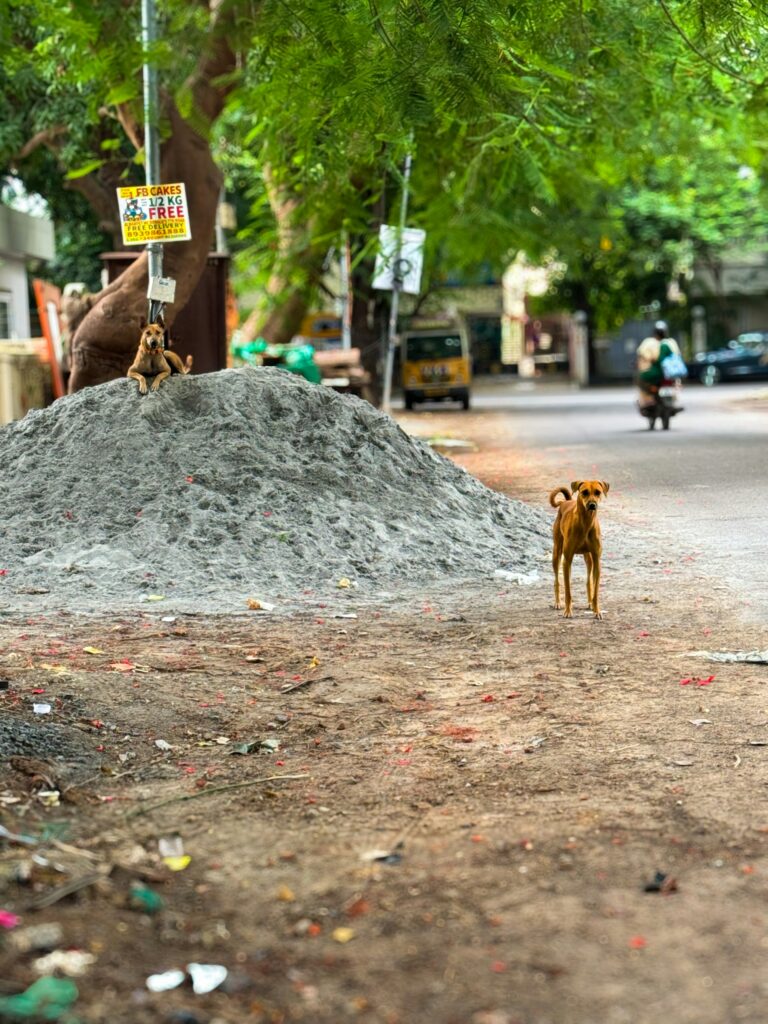
I grew up in Manila in the 80s and 90s, surrounded by street dogs. They're properly called aspins now, short for asong Pinoy, Filipino dog. The older term, askal, carries a class-discrimination sting most Filipinos grew up not questioning, and the Philippine Animal Welfare Society introduced aspin in 2007 specifically to move away from that. They had routes, favorite people, and loose social groups that shifted from day to day. Nobody managed them. They managed themselves.
I also have one specific memory of two of them chasing me as a kid, and for years I read that as proof street dogs were dangerous. It took becoming a Certified Family Dog Mediator to look back and realize the chase probably had nothing to do with aggression at all. Movement, especially a screaming, running kid, is one of the strongest chase triggers a dog has, whether the motivation behind it is fear, excitement, or plain instinct with nowhere else to go. That reframe changed how I think about a lot of "problem" dog behavior, not just my own memory.
Dogs didn't start out as pets
Raymond and Lorna Coppinger, whose decades of research reshaped how we understand dog origins, argued that dogs domesticated themselves. Rather than early humans capturing and training wolves, wolves that tolerated proximity to people gained access to a new food source at the edges of human settlements. Over generations, that tolerance became the dog. Whatever the exact mechanism (researchers still debate the details), the population the Coppingers studied most closely was the village dog: free-roaming, self-sustaining, and still, by their account, how most of the world's dogs live today.
Researchers studying free-ranging dogs in India, particularly Anindita Bhadra's work at IISER Kolkata, have documented something closer to loose, flexible family groups than a rigid pack hierarchy. Mothers raise pups with help from other dogs. Bonds form around specific people, places, and resources. Dogs move fluidly between solitary time and social time depending on the day. None of it is managed by a person. All of it is decided by the dog.
The piece most pet dogs are missing
This is where it gets relevant for the dog on your couch. A dog barking at the window, pulling toward every scent on a walk, or guarding a spot on the couch isn't malfunctioning. Genetics and environment shape each other, and a dog bred from generations of free-roaming ancestors, placed in a home where every outing is scheduled and every decision is made for them, is going to feel that mismatch somewhere. Sometimes it shows up as anxiety. Sometimes as reactivity. Sometimes just as a dog who seems restless in a life that looks, from the outside, comfortable.
Street dogs (lovingly sometimes called "Streeties") have almost none of what we consider "care" by modern standards. No vet visits, no scheduled meals, no soft bed. But they have something a lot of pet dogs are missing: choice. The freedom to move through their environment, choose their own company, and make small decisions all day long.
I see this even in my own home. My dog Rei was a street dog before he came to me. His reactivity isn't fear-based, it's frustration. He wants to greet every person and every dog he sees, and a leash and city rules don't allow it. I used to file that under "whatever happened before I knew him." Now I think about it differently. In the Four Pillars Framework I built for street and shelter dogs, Rei gained real Safety and Trust the day he came inside. Where I'm still working is Gradual Integration, the pillar that separates integration from assimilation: a dog becoming part of family life while keeping who they actually are, rather than a dog expected to suppress their real self to fit our terms. Rei wanting to greet the world isn't a flaw. It's who he is. The work is giving that trait a legitimate outlet instead of just more rules against it.
Why this changes how we approach "training"
Understanding a dog's behavior has to come before trying to change it. A dog who barks, chases, guards, or reacts isn't a dog that needs correcting so much as a dog whose instincts don't have anywhere appropriate to go. That's the gap a Behavioral and Wellness Assessment is built to find, not obedience gaps, but welfare gaps: where a dog's genetics, environment, and history are asking for something their current life isn't providing.
If your dog's behavior has you stuck between "this is just who they are" and "I need to fix this," that question is usually the wrong one. The better question is what instinct is showing up, and what would it take to give it somewhere to go.




Leave a Reply