This post is part of the Dogs & Neurodivergent Families series — an ongoing collection of essays on what it actually looks like when a reactive dog and a neurodivergent family member share a home. Written from two perspectives: Certified Family Dog Mediator and parent. You can read the series from the beginning here, or jump to any post below.
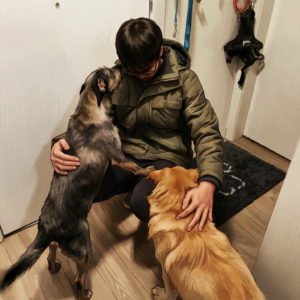
We got Rosco when my son was seventeen.
I want to say that because it matters. People imagine a young child when they picture a neurodivergent kid with a dog — small, easily redirected, manageable in scale. My son at seventeen was none of those things. He was a teenager. A big one. And he moved through the world the way a lot of autistic people do — with heavy hands, heavy feet, no real sense of how much force he was using until it had already been used.
His voice is either loud or almost inaudible. There's very little in between. When he's happy and engaged, he's loud. When he's frustrated, he's loud in a different way — sharper, and his body changes with it. The movement becomes choppy. Erratic. Like a signal breaking up. It doesn't look like anger to me anymore, not after all these years, but it reads as unpredictable. And unpredictable, to a dog, is its own kind of loud.
I knew all of this about my son. I had seventeen years of knowing it. What I hadn't thought about — not really, not until Rosco was in the house and I started paying attention — was what my son's body language looked like from Rosco's perspective.
Dogs are sensory animals living in a sensory world. They track movement, sound, smell, tone, posture — constantly, involuntarily, because that's what their nervous system is built to do. Unpredictable movement isn't just surprising to them. It's data. It says: something is happening that I can't predict. I don't know what comes next. And a nervous system that can't predict what comes next is a nervous system that stays on alert.
My son wasn't trying to be unpredictable. He wasn't doing anything wrong. The heaviness in his hands when he reached for Rosco wasn't carelessness — it's simply how he's wired, how he experiences his own body in space. His voice at full volume wasn't aggression — it's just where his volume dial tends to sit. And when he got frustrated and his movement went choppy and sharp, that wasn't a threat. It was his nervous system doing what it does.
But Rosco didn't know any of that. Rosco just knew what he was sensing: a large, unpredictable presence that was sometimes gentle and sometimes sudden, whose voice spiked without warning, whose body shifted in ways that were hard to read. All of that was going into Rosco's stress bucket — sometimes a little at a time, sometimes quite a lot at once — whether or not anyone in the room was tracking it.
I was often not tracking it. I was tracking my son.
There's a version of this conversation that becomes about managing the teenager, or training the dog, and I want to be careful not to go there. Because that's not what I'm talking about.
What I'm talking about is that both of them were navigating something real, and only one of them had anyone paying close attention to how they were doing.
Rosco communicates stress the way most dogs do — in a language that's easy to miss if you haven't learned to look for it. He yawns when he's not tired. He does a full-body shake-off when nothing has gotten him wet. He licks his lips. He repositions himself, just slightly, just out of easy reach. He leaves the room.
That last one is the one I started noticing first. He'd be settled somewhere, and then my son would come in — not doing anything dramatic, just entering the room in that way he has, heavy-footed, maybe mid-conversation with himself or with me, voice carrying — and Rosco would quietly get up and go somewhere else. Not dramatically. Not cowering. Just... choosing a different room.
I knew what it meant by then. He was telling me, in the only way he had: I need a bit less of this right now.
The problem is that a dog who keeps choosing a different room, day after day, in response to a family member, is a dog who is managing chronic low-grade stress. And chronic low-grade stress doesn't always look like a dog in crisis. Sometimes it looks like a dog who is just a little more tense than they used to be. A little slower to settle. A little quicker to startle. You don't always see it building until something tips.
I also had to reckon honestly with the physical piece.
My son's hands are not gentle by default. He has to think about being gentle — consciously, deliberately — in a way that a lot of people don't. When he pets Rosco without that conscious thought running, it's heavier than Rosco wants. And Rosco, to his credit, has learned to say so — he moves away, he turns his head, he does the small things that mean that's enough. But a dog who keeps having to say that's enough is a dog who is working harder than they should have to in their own home.
This is not about blame. I want to say that again because I mean it: this is not about my son being careless, or unkind, or unaware. He loves Rosco. That's not in question. But love doesn't automatically translate into the physical regulation that most dogs need from the humans they live with — and for some people, that regulation is genuinely hard. It requires effort and attention that a dysregulated nervous system doesn't always have available.
So the gap has to be filled somewhere else. And that somewhere else is me.
This is the part that doesn't get talked about in the conversations I've seen about dogs and neurodivergent families: someone in the house has to be the dog's advocate. Not in a dramatic way. Not in a way that pits one family member's needs against another's. Just in the quiet, consistent way of a person who is watching — who notices when Rosco has moved to the far side of the room and understands why, who makes sure there's always a space Rosco can go that is genuinely his, who steps in when an interaction needs to end before Rosco has to say so himself.
This is, in a real sense, what Family Dog Mediation is about. Not training the dog into tolerating more. Not teaching him to override his own signals. But understanding what he needs to feel okay, and making sure those things exist in the house, even — especially — when the house is a lot.
For Rosco, what that has looked like practically: a space that is always his and that my son has learned, over time, to respect. Decompression walks that are genuinely decompression — slow, led by Rosco's nose, not asking anything of him. A predictable rhythm to the day where he can anticipate what's coming, even when other things are unpredictable. And me — paying attention. Not constantly. But enough.
My son has grown into understanding Rosco better than I expected, honestly. It took time, and it took me explaining things in ways that made sense to him — not "be gentle" as an abstract instruction, but specific and concrete: put your hand out, let him come to you, watch where his head goes. He can do it. He just needs the explicit version, not the assumed one. Which, if you've been reading this series, will sound familiar.
Both of them are doing their best with the wiring they have. That's the thing I keep coming back to, in this work and in this family.
My son's heavy hands and his too-loud voice and his choppy, erratic movement when frustration hits — none of that is a choice. It's his nervous system, doing what it does. And Rosco's retreat to the far room, his lip-lick, his quiet preference for the space where things are a little less unpredictable — none of that is a behavior problem. It's his nervous system, doing what it does.
The question is never which one of them needs to change. The question is what understanding looks like when you're holding both of them at once.
Most of the time, for us, it looks like paying attention. Noticing when the bucket is getting full before it tips. Making sure there's always somewhere quiet to land.
That's not a perfect system. Some days are harder than others. But I've learned from both of them that perfect was never the point anyway.
The point is to keep asking: what do you need today? And then actually listening for the answer — in whatever form it comes.
If you've never thought about what your household looks like from your dog's perspective — the sounds, the unpredictability, the moments nobody is watching them — a Behavioral and Wellness Assessment is where that picture gets built. We look at the whole environment, not just the behaviour that comes out of it. Understanding before strategies, always.
The Dogs & Neurodivergent Families Series
What Raising My Child with Autism Taught Me About Understanding 'Difficult' Dogs
Stop Drilling Commands, Start Teaching Skills: A Mom and Dog Trainer's Perspective
Progress Is Not a Straight Line
What Your Dog Is Living Through in a Neurodivergent Home
Two Nervous Systems, One House: When Your Dog and Your Child Are Both Dysregulated
Choosing a Dog When You Have a Neurodivergent Child: What the Breed Lists Don't Tell You
The Bond That Looks Different: When Your ND Child and Dog Find Each Other
What Nobody Tells You About Having a Dog in a Neurodivergent Home



Leave a Reply